★4.9 Google rated 🎵
100+ reviews from our local Gahanna families 🎵
Serving the Gahanna community since 2010 🎵
Unlimited makeups* 🎵
Change your schedule at any time 🎵
Simple, transparent pricing 🎵
Family discounts 🎵
Neurodiversity-affirming music lessons 🎵
Two-teacher model: Music Lab + instrument 🎵
Unlimited adult Music Lab time 🎵
Year-round performance opportunities 🎵
Annual benefit concert for local food pantry 🎵
Conveniently located near Hamilton & Morse 🎵
Book a 4-week trial today!
Jazz began with African American musicians in the early 1900s. Despite some less reputable beginnings, this mix of European, Latin, and African American musical styles led to many of the popular music genres today, like R&B and rock and roll. Jazz is an American classical music genre.
As you can hear, jazz music creates complicated melodies and rhythms. It’s difficult to define but you learn to know it when you hear it. It also has heavy lean into improvisation and syncopation, which leads to its unique sounds. Because of those two qualities, jazz isn’t meant to be read on a page of music but experienced live.
The ‘Roaring 20s,’ also known as the Jazz Age, are long past, but jazz is still very alive and very American. Below is the playlist for our students to learn more about jazz.
Michelle Tuesday Music School held its 2024 Beach Party Recitals the weekend of August 9-11. We encourage all students taking music lessons at Michelle Tuesday Music School to play in our recitals and other performance opportunities. We host concerts at least four times per year, and we never charge fees to join the events. Many of our events, like this one, are coupled with a party. That way, our musicians who aren’t ready to play in front of an audience yet can just watch and enjoy the party.
Friday Night Teen & Adult Only Recital
Our Friday night Teen & Adult Only concert featured performances by adult music students learning piano, voice, guitar and mallet percussion. Jane played “Amazing Grace” on guitar, her debut performance as a student taking adult guitar lessons, and she did great! The percussion teacher accompanied her glockenspiel student on the gorgeous new studio Boston grand piano for a rousing, jazzy rendition of “You’ve Got a Friend in Me” from Disney’s Aladdin. Our audience took our teen & adult recital “rule” to heart, and they screamed, hooted and hollered before and after each performer, because it calms the nerves of the musicians, and it makes the event more fun for everyone.
Saturday and Sunday Recitals
Saturday and Sunday afternoons included contributions from our younger music students. The musicians featured are enrolled in music lessons on a variety of instruments. The student performers are taking:
songwriting lessons,
guitar lessons,
voice lessons,
violin lessons,
recorder lessons,
ocarina lessons,
drum lessons, and
piano lessons.
Performers learning piano played their prepared pieces on our shiny new lobby grand piano. Our aspiring musicians delighted their audiences with well-known favorites: “Michael, Row the Boat Ashore” on violin; “Yankee Doodle” and “Old MacDonald” on piano; vocal performances of “Part of Your World” and “Candle on the Water”; and from our students learning guitar, a variety ranging from the classical “Spanish Waltz” to an improvisation on “The Wind Cries Mary” by Jimi Hendrix.
Ocarina and Songwriting Lessons
Perhaps the most unique performances of the weekend were offered by Felix, who played “Amazing Grace” on ocarina (of Nintendo’s Zelda fame), and Millie singing her original composition, “The Good Old Days,” from her work-in-progress two-act musical starring her dog, Gwinnie. Watch for the upcoming puppet show, Gwinnie, when Millie has completed her first, but certainly not last, magus opus. Millie tells us she has already begun work on the sequel!
Beach-Themed Games and Prizes
After each 30-minute block of performers, the music students enjoyed the party activities outside, including beach bingo, a duck pond, and sidewalk chalk artwork around the perimeter of the music school, plus fabulous prizes to be had by all.
Kudos to the Student Musicians!
Thank you to all of the performers, parents, teachers and staff who made our Beach Party Recital a smashing success. Your teachers are very proud of you, and it’s always wonderful to see everyone having a great time.
Next Performance Event
Mark your calendars for our next performance opportunity. The annual MTMS Halloween Party Recitals have been our most popular concert each year for nearly a decade and a half. Sign-ups open October 14th!
Staff setting up for the Beach Party Recitals.Alex on violin, performing “Michael, Row the Boat Ashore” to the delight of her audience.Felix on ocarina. This was his second recital, so he’s officially a pro!Ella delighting her audience on our beautiful Boston grand piano.An engaged and entertained audience, ready for the next performance.
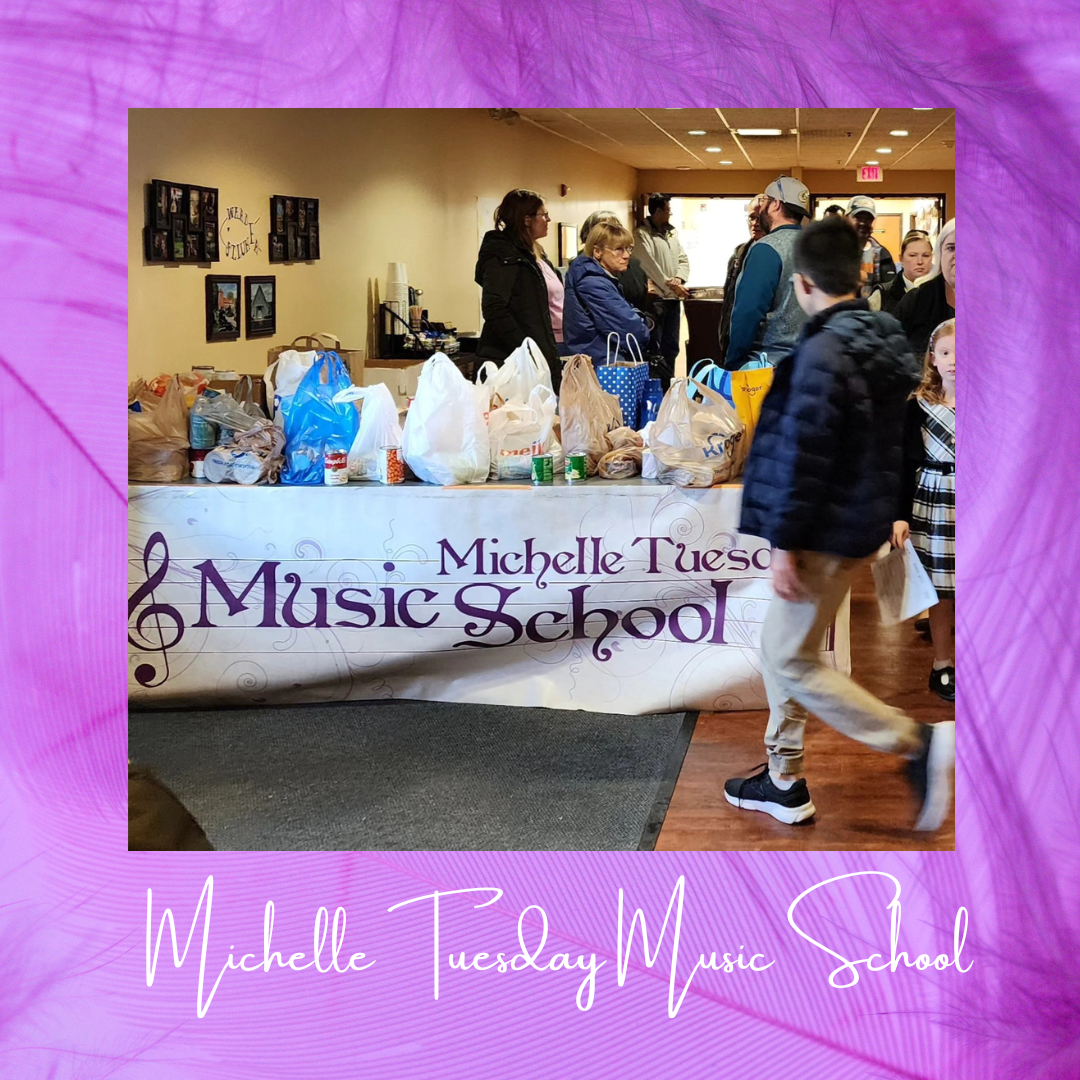
Thank you everyone for making this Winter Benefit Concert a success. Michelle dropped off the donated items at GRIN (Gahanna Residents In Need) today. The final haul was 184.5 pounds of food!
Great job, students, for your performances! You make the music come to life. We can’t wait to enjoy your next performance event.
The first day of spring is here. It may not feel like it quite yet, but warmer days are coming.
Antonio Vivaldi’s best known works are the Four Seasons, a group of four violin concertos that each gives expression to one season of the year. Spring is linked below. These seasonal concertos represent flowing creeks, singing birds, a shepherd and his dog, buzzing flies, storms, drunken dancers, hunting parties from both the hunters’ and the prey’s point of view, frozen landscapes, and warm winter fires. This was a musical revolution of concept- and Vivaldi kept notes and even wrote sonnets to go with each concerto. This is one of the earliest and most detailed examples of what would become “program music” (music with a narrative element).
Vivaldi published the Four Seasons in 1725. There is some debate on how much earlier they were written, whether the sonnets were written to go with the music or vice versa, and whether Vivaldi or someone else wrote the sonnets. Each concerto has three movements (allegro, largo, allegro or fast, slow, fast) and the sonnet was likewise broken into three parts.
Spring sonnet translation by Armand D’Angour Allegro Springtime is upon us. The birds celebrate her return with festive song, and murmuring streams are softly caressed by the breezes. Thunderstorms, those heralds of Spring, roar, casting their dark mantle over heaven, Then they die away to silence, and the birds take up their charming songs once more.
Largo On the flower-strewn meadow, with leafy branches rustling overhead, the goat-herd sleeps, his faithful dog beside him.
Allegro Led by the festive sound of rustic bagpipes, nymphs and shepherds lightly dance beneath spring’s beautiful canopy.
MTMS is excited for Abigail Voigt to begin as Reception Lead. She’s been with us for some time now, and she has done well in her time as receptionist. She’s hardworking and dependable and friendly. Abigail has been a teacher and an at-home parent, and her family has always been music-oriented, which makes her a great fit at MTMS. Congratulations!