
This week our summer playlist is out! When you see our students, tell them how they did. I am always amazed how much their skills improve between each time I see them. This playlist is amazing as always. We can’t wait until the next time we get to showcase our students and their capabilities.
Category: MTMS Blog Posts
-
August Theme: Yodeling
The unmistakable sound of yodeling—rapidly flipping between chest voice and head voice—has long been associated with the snow-capped peaks of the European Alps. But this unique vocal technique began not as art, but as function: yodeling was originally a practical method of communication, designed to carry across vast, mountainous terrain.
What makes yodeling so distinct is the dramatic shift between vocal registers, often called a “vocal break,” which creates that signature warbling tone. It requires surprising vocal control and agility, making it both a fascinating study in technique and a fun musical challenge.
While yodeling’s exact origins remain somewhat mysterious, its influence spans continents and genres. In fact, this Alpine tradition helped shape the sound of early American Country music in the 1940s and ’50s. Country artists embraced yodeling’s expressive power, using it to add flair and feeling to their songs—creating a lasting link between European folk traditions and American roots music.
At Michelle Tuesday Music School, we believe that music lessons should go beyond notes and scales—they should build curiosity about music’s cultural roots. In our Lab this month, students explore the rich history and technique of yodeling with a lesson. The composition station challenges students to compose a short yodel of their own, while our listening station features examples of yodeling, linked below.
Parents can be part of the fun, too. Ask your student what they’ve learned about yodeling this month—you might be surprised by what they share! Better yet, try yodeling with them. It might lead to a few laughs, but it’s also a great way to connect with your child’s learning and cultivate a shared appreciation for the colorful history of music.
-
Kid Quotes
I love to read the students’ comments on the monthly theme. It’s a great way to know what they’re learning from the history and listening stations.
My favorite this month is from Noah – “didn’t know he was in the sixties and is dead” I’m sure there’s context to this but I feel the same way. Ollie felt they all sounded the same, but maybe that’s just a first impression to 60s pop music.
Liana – one song they were playing with a ball and dribbling, and one sounded like spring then summer or summer then spring. Her favorite lyric was ‘home is in your heart’.
Wynn – liked the words to Sweet Caroline, liked the songs where one instrument (drums or piano) started first and then the others joined in, and enjoyed the pictures.
Owen really liked the song titles, especially Sweet Caroline, he appreciated the realism in the songs, and he enjoyed the moving pictures.
Hayden noted that Motown records was incorporated on April 14th, 1960. The British Invasion brought groups like the Beatles to (American) audiences. In 1969, Woodstock brought more than 400,000 people together as an audience.
Penelope liked the lyrics, but also noted that the songs were based on what happened to people and it was a little scary.
Bela appreciated that there were a lot of female artists, Woodstock happened August 15-18, 1969, and that many British bands were influenced by Black American music.
Lillian especially liked Here Comes the Sun. Lyrics in the listening station were both happy and sad and she enjoyed the sounds of the instruments.
Zoey noted the lyrics are different from what you hear today, that it was old music, and some of the videos had black and white scenes.
I hear there’s a hint to our next month’s theme in the newsletter. See if you can figure it out with your students!
-
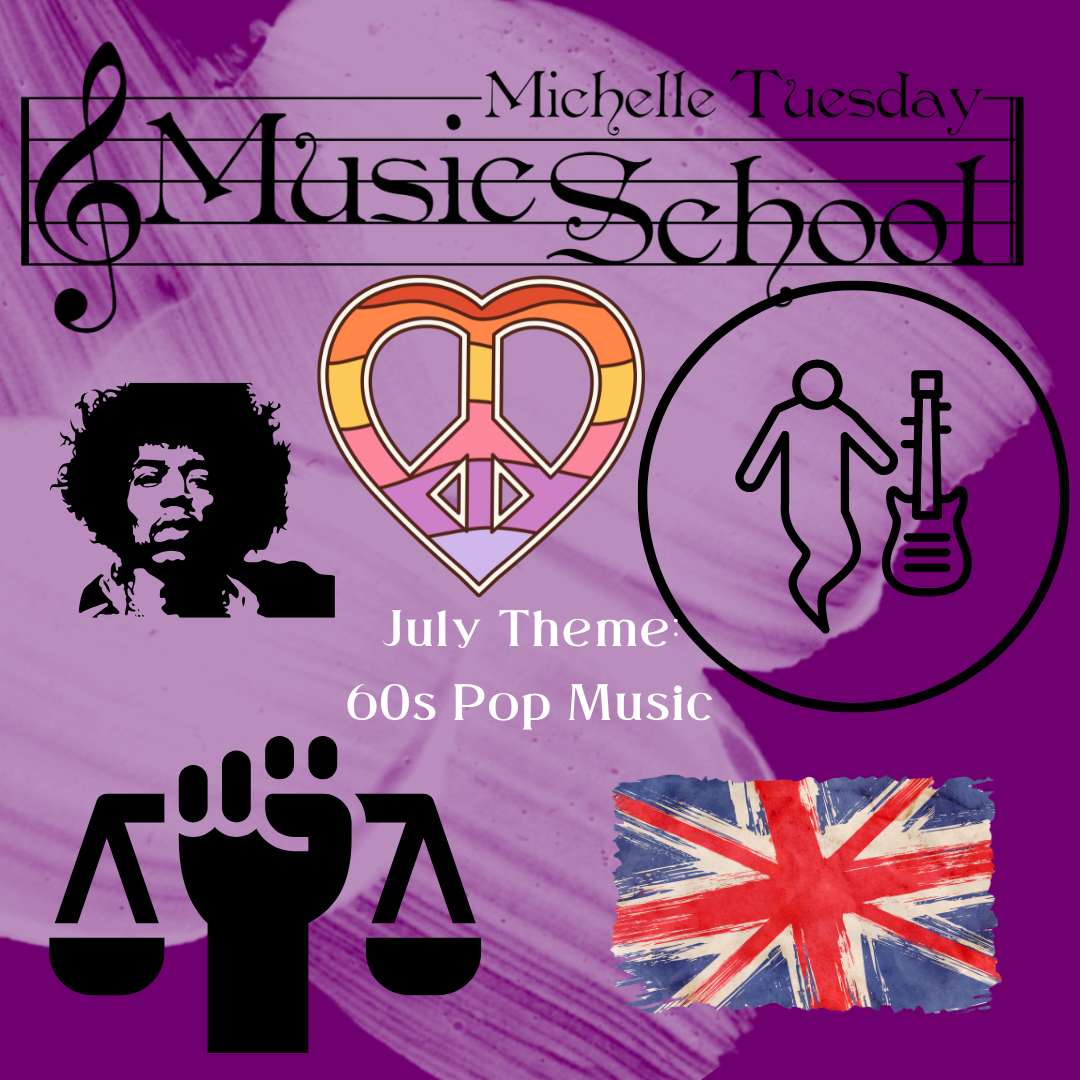
July Lab Theme: 60s Pop
🎶 The Soundtrack of a Generation: Exploring 1960s Pop Music 🎶
This Month’s Music Lab Theme at Michelle Tuesday Music SchoolLet’s take a trip back to one of the most iconic decades in American music history—the 1960s! This was a time when pop and rock music didn’t just entertain people—it inspired them, gave them a voice, and sparked movements. At Michelle Tuesday Music School, our students are diving into the sounds of the ‘60s this month in the music lab, exploring a time when music lessons weren’t just about reading notes—they were about expressing ideas.
Here are four major forces that shaped 1960s American pop music:
🇬🇧 The British Invasion Turns the Tide
In 1964, The Beatles took America by storm, and they weren’t alone. The Rolling Stones, The Who, and The Kinks brought a fresh British take on American rock and pop, and suddenly radio stations couldn’t play enough of them. Their catchy melodies and stylish looks made them teen idols, but it was their energy and songwriting that changed the pop music landscape—and pushed American artists to innovate fast.
🎤 Motown: Polished, Powerful, and Unforgettable
Over in Detroit, Motown Records was shaping what would be known as “The Sound of Young America.” Artists like The Supremes, Marvin Gaye, and The Temptations blended soulful rhythms with pop appeal, creating timeless tracks that still make people dance today. Motown didn’t just dominate the charts—it broke barriers, bringing Black artists into the mainstream and helping pop music reflect a more diverse America.
🎸 Folk Music Finds Its Voice
Folk artists like Bob Dylan and Joan Baez gave music a new job in the ‘60s: to speak up. Acoustic guitars and thoughtful lyrics became the tools of the trade for a generation that wanted change. These songs tackled real issues—civil rights, war, peace—and invited listeners to think, feel, and act. Folk wasn’t about flash; it was about message, and it brought meaning to the pop and rock scene.
🎸⚡ Jimi Hendrix and Psychedelic Rock Push Boundaries
Then came Jimi Hendrix—a guitarist unlike anything anyone had heard before. With feedback, distortion, and incredible showmanship, Hendrix transformed the electric guitar into a tool of wild creativity. Tracks like Purple Haze and All Along the Watchtower mixed blues, rock, and experimental sounds in ways that reshaped pop and rock music forever.
🎤🌼 Woodstock: The Music Festival That Defined a Generation
In 1969, everything came together at Woodstock. Nearly half a million people gathered for three days of peace, love, and music. It wasn’t just a concert—it was a cultural milestone. Performers like Janis Joplin, Jefferson Airplane, and of course, Jimi Hendrix took the stage. His rendition of The Star-Spangled Banner became an unforgettable moment in music history. Woodstock showed just how powerful music had become—as both an art form and a movement.
So whether it’s British guitar riffs, Motown grooves, folk lyrics, or psychedelic solos, the 1960s gave us a musical treasure chest. This month at MTMS, our students are diving into those sounds—through listening, discussion, and hands-on music lessons that bring the decade to life.
✨ Music lessons are more than just learning an instrument—they’re about understanding how music shapes the world around us. And the ’60s are the perfect place to start.
-
August Book Fair
As August approaches, Michelle Tuesday Music School is excited to announce the return of our Annual Book Fair—an event that brings music lovers, generous hearts, and community spirit together in one place. This free event is open to the public, and it’s a great way to upgrade your collection of music books while giving back to a cause we care deeply about.
♻️ Refresh Your Musical Library
Have music books you’ve outgrown or no longer use? Bring them to the MTMS Book Fair! Whether you’re looking to exchange older materials or simply explore something new, this event is the perfect opportunity to discover a better fit for your musical goals. All books and sheet music will be available free of charge to attendees—no strings attached!
💛 Supporting GRIN: Gahanna Residents In Need
The Book Fair also serves a greater purpose. We’re proud to continue our partnership with GRIN (Gahanna Residents in Need), our chosen charity for MTMS fundraising efforts. While the event is free, we welcome donations of non-perishable food items or cash to support GRIN’s ongoing mission to help local families in need. It’s a simple yet powerful way to make a difference while enjoying the joy of music.
📚 Now Accepting Donations
We’re currently accepting donations of music books and sheet music in good condition. If you have unused materials collecting dust at home, consider giving them a new life through our Book Fair. Donations can be dropped off at MTMS during regular business hours.
Whether you’re a student, a parent, a teacher, or just someone who loves music, we invite you to be part of this meaningful event. Stay tuned for official dates and full event details—we can’t wait to see you there!