★4.9 Google rated 🎵 100+ reviews from our local Gahanna families 🎵 Serving the Gahanna community since 2010 🎵 Unlimited makeups* 🎵 Change your schedule at any time 🎵 Simple, transparent pricing 🎵 Family discounts 🎵 Neurodiversity-affirming music lessons 🎵 Two-teacher model: Music Lab + instrument 🎵 Unlimited adult Music Lab time 🎵 Year-round performance opportunities 🎵 Annual benefit concert for local food pantry 🎵 Conveniently located near Hamilton & Morse 🎵 Book a 4-week trial today!

Category: MTMS Blog Posts

  • New Year for Music

    New Year for Music

    I’m excited to say Happy New Year every chance I get. A new year may not always be a fresh start, but as we measure time it is a great chance to try new things and let go of the things that are not good to hold on to anymore.

    One great thing to start your new year in the right direction? Music, of course! Whether you’re thinking about an instrument or singing, we’re here to guide and challenge you to new achievements. Whether you’re new to our school or you’ve been with us from the beginning, I’d like you to look at your music for a few minutes and just consider where you are. What do you want to learn? What is your ultimate goal? Does it make you happy? Is something frustrating you and you need to come at it from a different angle?

    These questions might not be on your mind all the time, but it is good to check in once in a while to know you’re on the right track. Don’t be afraid to talk to your teacher about what you want to achieve in your lessons. Also feel like it is all right to ask what a particular lesson might be teaching you, and discuss whether or not you’re getting it. We love music, and we want you to love it, too. See you soon!

  • Do You See What We See?

    Do You See What We See?

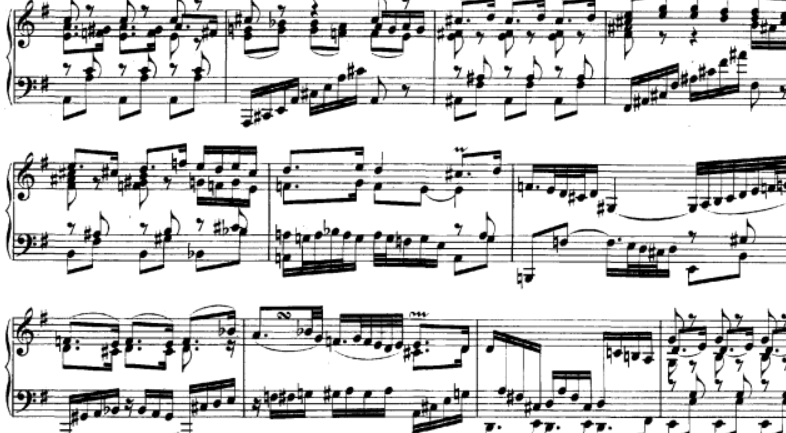
    At MTMS, one of the lab stations allows music students to compose their own selections. Sometimes this results in some hilarious song titles, and definitely original scores. Listed are several that reached above and beyond the “random” or “untitled” to stand out from the rest. We appreciate every composition, and thank you for making us giggle. Two songs are linked to listen to, and one score is in PDF because you just have to read it. Please, share our joy in these songs.

    Sorry, There is no song here. by Trinh

    The Sweaty-Toothed Madman by Ashwin Kumar

    Cabinet Battle #1 transcribed by Aishu Pandian

    Chocolate Bar and Madman by Nithya Sabarinathan

    Blob by Soha Dabholkar

    at this point I’m just clicking random things by i think i broke it

    When Mario eats a Giant Cheeseburger by Dylan McCarty

    Why you shouldn’t buy plastic stringed “Guitars” from the dollar tree by Gabriel Pugliese Inspired by his sister Elliana Pugliese

    Squeak, Squawk, Shreak by Samaira Dabholkar

    The Slur Song by paul McCarty

    WEIRD 😐 by I was printing something 😐

    space is conscious by Dylan Stultz

    The Mystery of the OOF by Jayden A

    I Aeth Yapapas by Try and Unscramble the Title

    The One and Only Meow Meow by J.S.

    Music? by Nikolas Vansach

    Rumors can scare you by Alison Popelka

    Playing the Guitar by Naomi Wong (a pianist)

    space = face by Lucy Daubenmire

  • Learn Your Way

    For many years, schoolrooms all looked the same: a teacher lectured from the front of the room while obedient students sat in rows and absorbed knowledge (at least that was the goal). I’ll bet some of you even remember rooms like this (I know I do). Schoolrooms now are a completely different story. Students are often moving as are the teacher (or teachers). There’s noise (and what may seem to be chaos) and the only quiet may be test day. Why this change though?

    One reason is the use of differentiation in the classroom as teachers try to reach all students. The other is teachers adapting to learning styles. Yes, even in something like a music class.

    Depending on which school of thought you adhere to, there are either five or seven learning styles. The seven learning styles to be considered are visual, aural, verbal, physical, logical, social, or solitary.

    1. Visual–also called spatial means that students learn better by reading or seeing what they are trying to understand.
    2. Aural–means that students learn better by hearing or having music involved in their lessons.
    3. Verbal–means that students want to speak their lessons aloud.
    4. Physical–also called kinesthetic means that students want a hands on portion to their lessons or to learn by doing.
    5. Logical–means that students apply logic to their learning.

    These last two are not always included with the others, but can help a teacher decide whether to group students or let them work alone.

    1. Social means a student prefers to work in a group.
    2. Solitary means a student prefers to work or learn alone.

    Now all of these learning styles do not mean that is the only way the student learns, but just means that might be the way they learn best. It also means they might learn best in more than one way. They could be a visual and an aural learner. Or a physical and a logical learner or any combination.

    What it all comes down to is there are many different ways to learn and no teacher should teach one way.

    If you’re curious about how you or a student learns, here’s a quick test to see. A better way is to talk with your student and find out how they feel they understand best and discuss different methods to learn and see how each of them sticks.

  • Getting Children to Practice

    Getting Children to Practice

    In order to improve, students must practice. While the teacher does as much as she can with the student in the classroom, encouraging the student to practice at home will also help.

    One good way to reward and keep track of practice at home (and that the Michelle Tuesday Music School encourages) is to complete a minute of practice per age. So if your student is five, that child should practice for five minutes a day. You can set a timer so they don’t over practice. Give her a small reward once she’s finished this time (a sticker is a good one) and keep track of her time. You might consider letting her pick a prize once she’s earned a certain number of stickers. That’s all up to you.

    At the school, she’ll get to prove that she has learned the song (and put in the time practicing), by playing it. If she shows she has mastered it, her teacher will put a sticker in her book and she’ll get a prize from the candy box. These little rewards will not only give her something concrete right away, but also give her the satisfaction of looking back through her book to see all the songs she’s mastered.

    There’s an old adage ‘Practice makes perfect’. Sometimes just a little goes a long way.

  • Lab Stations Virtual Tour

    Lab Stations Virtual Tour

    The lab has four stations for students to continue their music learning work at Michelle Tuesday Music School. Our students may spend all their time during a month at one station, like ear-training, or choose to switch stations on different weeks. Remember when you visit we wear masks and social distance, so there will only be one or two students in the lab at a time.

    Music Theory:

    At Station 1, our Music Theory station, students work on learning how to read notes, build chords, differentiate pitches and rhythms, and a variety of other skills that they can directly transfer to their lessons. Students use computer programs like Music Ace, Alfred’s EMT, and a new program, Utheory, to improve their skills. Music Theory also features our brand new game- Busted!, which works on identifying types of notes and clapping out rhythms with other students. 

    Ear Training:

    At Station 2, our Ear Training station, students may work on listening and echoing rhythms, matching pitches together, even or identifying different types of intervals and scales. This station is entirely iPad based, with apps for students of all different skill levels. Ear Training helps build the musical ear of all students, a critical skill that will be used and improved throughout their musical career. Station 2 also features one of our newest additions to the lab- our bean bag chair!  

    Composition:

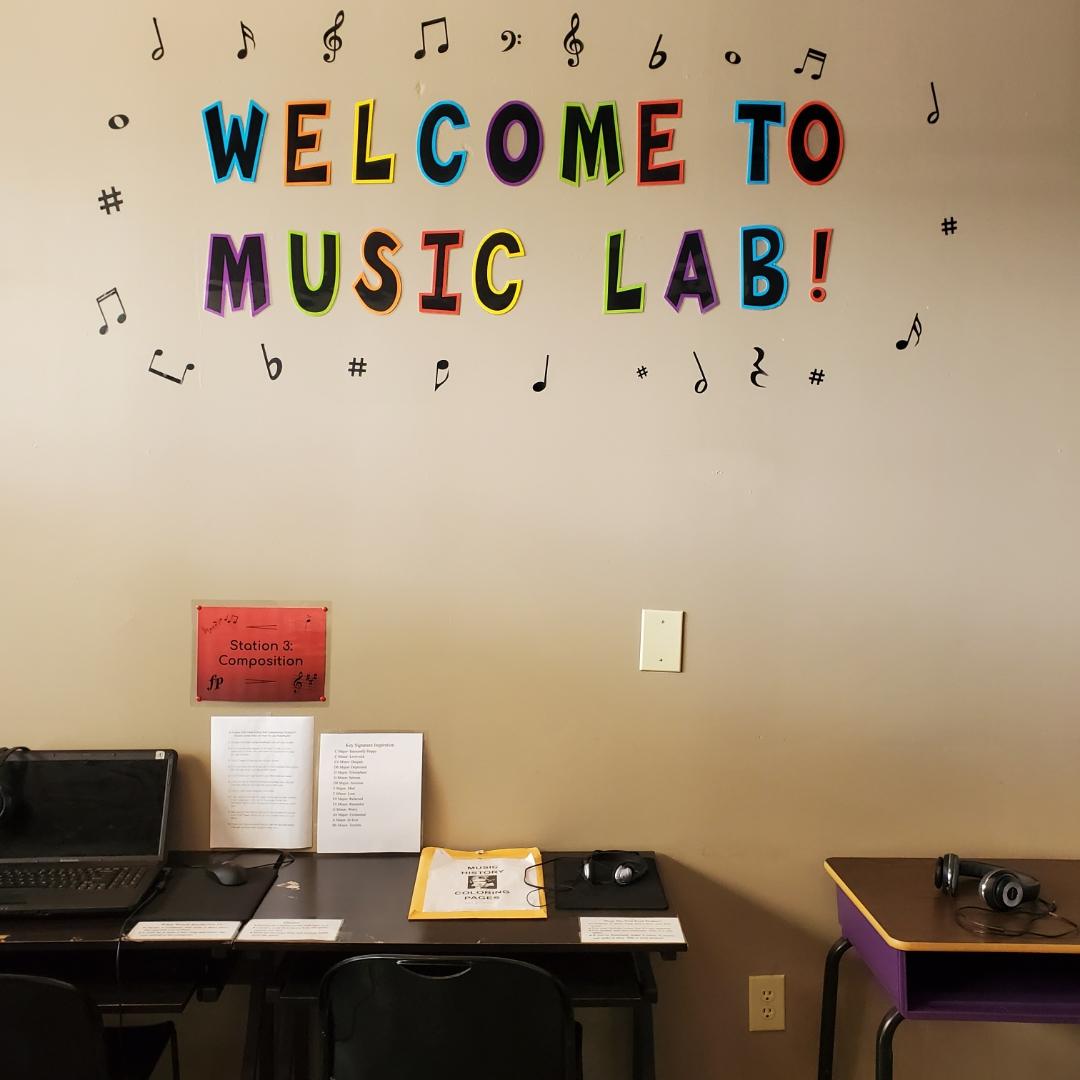
    Station 3, our Composition station, allows students to write their own music! Students of younger ages can use blocks to build rhythms of their own, while older students can use computer programs like Noteflight to compose their own songs. The station even has prompts ready to provide inspiration to students writing their own music, encouraging students to write about everything from how they feel that day, to writing a song based on a favorite composer.

    Music History:

    Station 4, our Music History station, teaches students about the history of famous composers or even the instrument they play. This station has new topics every month, exposing students to a variety of different parts of the history of music. October’s focus is on famous composers, time periods, and the history of instruments and genres. From Beethoven to the Beatles, students will learn about all kinds of music from the past. Our preschool age students may work on coloring pages of famous composers, while our older students read an informational sheet and then play a Jeopardy like game on the information they learned. Another option for our older students is a mini-independent research project on these same topics.

    Wherever our students spend their lab time, they are becoming better musicians through the virtual work. Can’t wait until you come and join us!