★4.9 Google rated 🎵
100+ reviews from our local Gahanna families 🎵
Serving the Gahanna community since 2010 🎵
Unlimited makeups* 🎵
Change your schedule at any time 🎵
Simple, transparent pricing 🎵
Family discounts 🎵
Neurodiversity-affirming music lessons 🎵
Two-teacher model: Music Lab + instrument 🎵
Unlimited adult Music Lab time 🎵
Year-round performance opportunities 🎵
Annual benefit concert for local food pantry 🎵
Conveniently located near Hamilton & Morse 🎵
Book a 4-week trial today!
Austin Young is an alumnus of Muskingum University with a BA in Music Education. Austin was bass section leader for Muskingum’s Concert Choir. As a part of Concert Choir, Austin sang for international audiences in Germany, Prague, England, and Scotland. Austin is in his 5th year teaching at Finland Middle School and Franklin Woods Intermediate as the Vocal Music Director. In his spare time, Austin enjoys evenings with his wife, Jess, and his infant son Luther.
Please join us in welcoming Austin to the MTMS Family! <3
If you didn’t know, Michelle was diagnosed with Type 1 Diabetes and Parkinson’s Disease in 2022. With those diagnoses she was able to get proper treatment and medication for both diseases. The year before was extremely difficult. Here is part of her struggle in her words, along with a glimpse into her recovery.
2021 was a difficult year. I lost 75 pounds without trying and spent most of the year binging on Netflix shows. I couldn’t even play games. I just stared at the TV. All. Year. Don’t get me wrong; I got the work done that needed to be done, but it was the bare minimum.
That’s the year I lost my voice. I lost the other instruments, too: piano, guitar, violin, drums. But I could still play slow songs, and piano was decent since the PD only affected my right side at first. My left hand picked up the burden. But I couldn’t sing.
I have a great support network, so I didn’t wallow in depression. But now that I’m medicated for both diseases and have regained maybe 90% of the mobility I lost in ’21, I’m working hard to get all the instruments back, including my beloved voice, which I didn’t realize was such a dear friend. Frankly, I’m pissed at PD for taking it away from me.
Quick side note: the doctors and all the literature blame the PD, and it’s well established that PD impacts the voice. But it was the T1D that stole my energy: my cells weren’t getting any fuel. That surely contributed to barely using my voice for a year.
Either way, the ENT shoved a camera up my nose and proclaimed: vocal fold atrophy.
So I saw a speech therapist for about six weeks, and I’ve been working hard to get my voice back. It’s so slow going that I decided to document the journey, maybe just to convince myself the progress is worth it. I took some earlier videos, but I need to dig through them to build the history.
26 Oct 2023
Great work, Michelle! Keep singing. We’re going to join in on the next verse.
Teaching music to preschoolers is incredibly rewarding. It can also be challenging. Preschoolers are enthusiastic, energetic learners, which makes them fun to teach, but it also means a lot of squirrely behavior in the classroom.
Start with a “Hello” song. End with a “Goodbye” song.
Listen to music and create art that matches the music. Example: listen to Blue Danube and color a river.
“Emotions” game: listen to a song and ask the children if that song makes them feel happy, sad, or scared. Each child gets to draw an emoji or attach an emoji sticker demonstrating that feeling onto a card. While listening to the song, the children may color and decorate their emotions card.
Play coffee can drums to practice Kodaly rhythms (ta ta, ti-ti-ti-ti).
To the tune of “Mulberry Bush”, sing and act out with claves: “This is the way we tap our sticks…”. Add variations like “hammer our sticks” or “scrape our sticks”, and let the children make up their own variations (“row the boat”, “sweep the floor”, etc.)
Act out songs with guided movement, like “Ten in the Bed” or “If You’re Happy and You Know It”.
Have each child choose a food to speak in rhythm like “Pepperoni Pizza” or “Strawberry Pop-Tart” and play it on different instruments.
Use the Music for Little Mozarts book and accompaniment series to play “Racing Car” on the piano, which features glissandos (representing the race) and tap-tap-tap on three black keys (representing a honking car going “beep beep beep”).
Play an energetic song and allow the children to dance with colorful scarves. Add the “Freeze Game” by pausing the song every so often, which is the cue for the kiddos to freeze in place until the music starts back up again.
Music solos: each child gets to take a turn “performing” (improvising) on an instrument. Time the performance, allowing 30-60 seconds to jam. When time is up, the performer bows to the audience (the rest of the class), while the audience applauds.
Do you have music activities you’ve used successfully with preschoolers? How about activities that didn’t work? We’d love to hear some of the ideas you would add to the list.
Occasionally we ask our students questions and they tell us their answers. I like to give people a chance to respond here, too, and then report back about it next time on the blog.
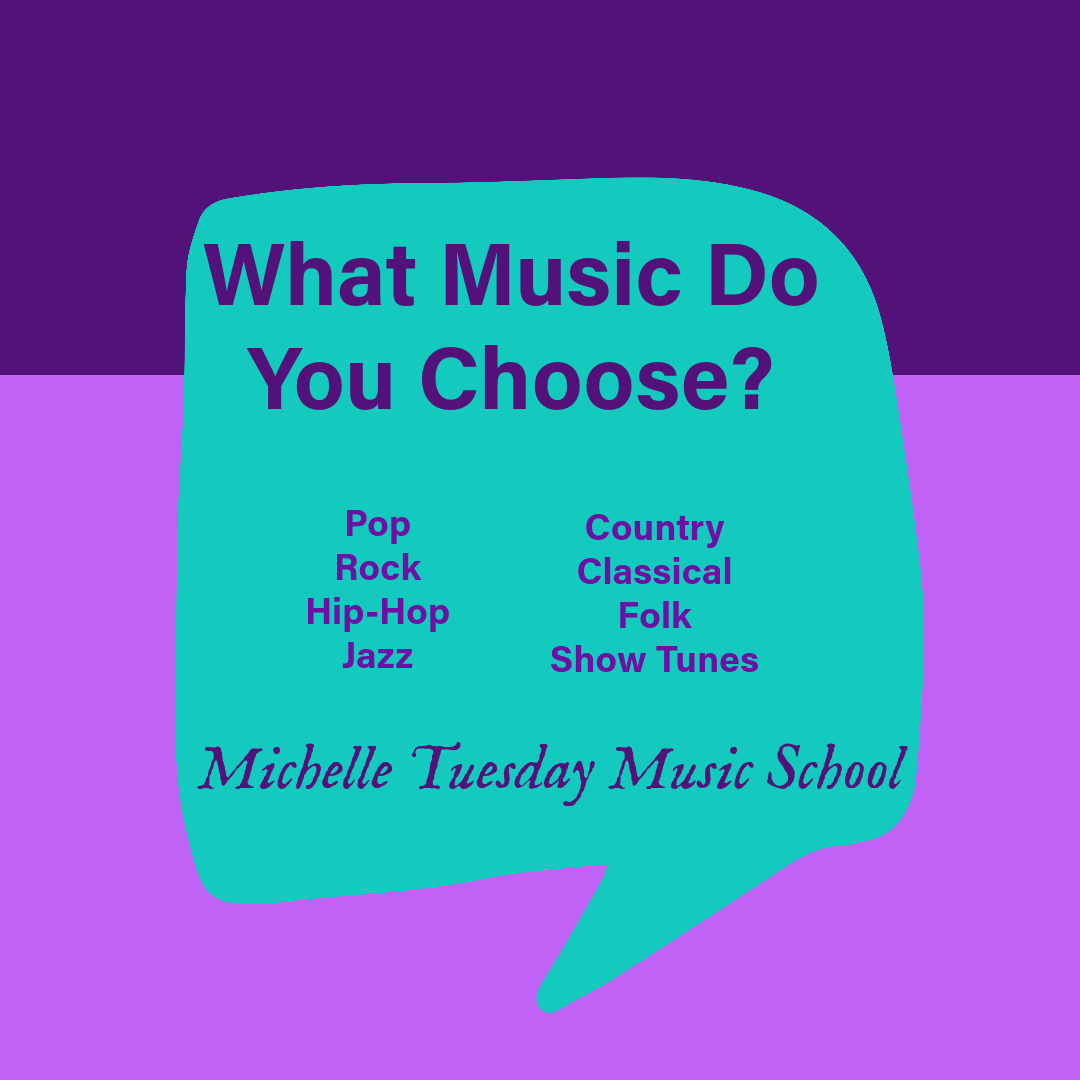
What’s your favorite genre of music? Pop Hip-hop Rock Jazz Country Classical Folk Show Tunes
While we know genres that aren’t included in the list, I encourage you to try these if you’ve never, and rank what you like for yourself or what you listen to with your kids, or what you put up with in a public space versus what makes you want to leave right away. Music is everywhere (and I love it) but we don’t all react to all of the music in the same way. I guarantee if I hear Christmas music in July in my kid’s room, I’m not going to stay too long. I linger longer if either kid is practicing an instrument, however.
Enjoy the day, enjoy the music, and let us know what you love to listen to.